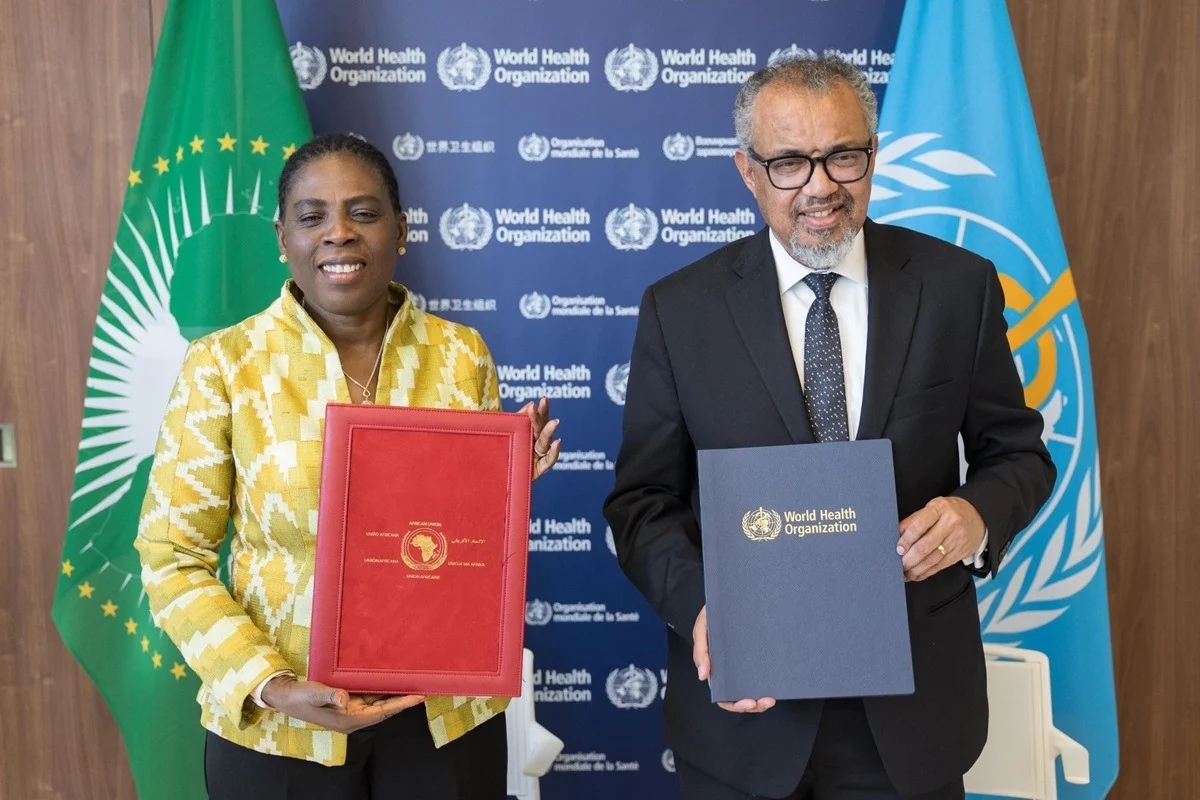
GENEVA — In a major development for international health governance and regional cooperation, the World Health Organization (WHO) and the African Union (AU) Commission have officially renewed their longstanding strategic partnership. The milestone agreement was sealed through the signing of an updated Memorandum of Understanding (MoU) on the sidelines of the 78th World Health Assembly in Geneva, marking a renewed chapter in multilateral health diplomacy.
This updated framework reaffirms a joint, unwavering commitment to advancing health security, driving universal health coverage (UHC), and fostering sustainable development across the African continent. The signing comes at a critical juncture in the global health landscape, characterized by unprecedented financial challenges, shifting geopolitical dynamics, and tightening fiscal constraints that threaten to undermine decades of public health progress in vulnerable regions.
Furthermore, the renewed partnership underscores the growing leadership of the African Union in fostering collective action, championing inclusive partnerships, and building robust regional resilience. By cementing this alliance, the agreement positions the Department of Health, Humanitarian Affairs, and Social Development of the AU Commission directly at the heart of the continent’s health policy implementation efforts, ensuring that continental strategies are matched by coordinated global technical support.
The landmark agreement was formally executed by Her Excellency Ambassador Amma Adomaa Twum-Amoah, Commissioner for Health, Humanitarian Affairs, and Social Development, who signed on behalf of His Excellency Mahmoud Ali Youssouf, Chairperson of the African Union Commission. They were joined by Dr. Tedros Adhanom Ghebreyesus, Director-General of the World Health Organization. Together, the leaders heralded the pact as a defining moment for primary health care and universal health coverage across member states, signaling a unified front against both chronic and emerging health crises.
Speaking at the high-level signing ceremony, Commissioner Twum-Amoah emphasized the immense strategic importance of the agreement and the pivotal role the AU continues to play in shaping the trajectory of Africa’s health landscape. She noted that the framework provides a robust platform for addressing the systemic vulnerabilities exposed by recent global shocks.
"This Agreement marks a new chapter in AU-WHO cooperation," Commissioner Twum-Amoah stated during her address. "By working together more closely, we can better respond to the health needs of our populations and ensure that no one is left behind. The African Union values WHO’s central and leading role in global health and looks forward to deepening this strategic partnership in support of our shared goals."
In a particularly resonant message concerning the future of African self-reliance, the Commissioner underscored the urgent need to fundamentally shift how nations approach public sector funding. "We need to move from budgeting for survival to planning for health sovereignty," she added, capturing the aspirational spirit driving the continent’s institutional reforms.
The newly updated MoU builds directly upon the solid foundation laid by its predecessor, the 2019 Memorandum of Understanding. However, the latest iteration goes significantly further by streamlining and strengthening collaboration across all operational entities of the African Union. It explicitly aligns technical and financial efforts in support of Africa’s overarching health priorities, while setting the stage for enhanced, institutionalized cooperation between the WHO headquarters, regional offices, and AU specialized institutions.
Crucially, the agreement reaffirms the WHO’s central technical and normative leadership role in both global and regional health architecture. It solidifies the agency’s unwavering commitment to supporting the African Union and its specialized bodies in achieving the health-related Sustainable Development Goals (SDGs), ensuring that technical guidance is contextually relevant, scientifically rigorous, and readily adaptable to diverse national realities.
Dr. Tedros Adhanom Ghebreyesus, reflecting on the urgency of the moment, addressed the severe macroeconomic pressures currently bearing down on developing nations. He pointed out that the timing of the agreement could not be more vital, as international solidarity faces severe strain from shifting donor priorities and tightening foreign assistance budgets.
"This renewed agreement comes at a critical time, as cuts to bilateral aid imperil the health of millions in Africa," Dr. Tedros said. "It reflects our determination to translate our partnership into tangible results for the people of Africa, and support countries to leave behind the era of aid dependency and transition to sustainable self-reliance. We are proud to stand with the African Union in driving forward the health priorities of the continent."
The timing of this renewed strategic alignment carries deep political and operational significance. It occurs against the backdrop of the African Union’s increasingly prominent voice in global health governance—a status significantly bolstered by the AU’s historic inclusion as a permanent member of the G20. This elevated global standing allows African leaders to shape international financial architectures and health security frameworks with greater authority. Simultaneously, the MoU highlights the WHO’s ongoing, indispensable role as a trusted technical, normative, and operational partner capable of delivering results at scale.
By bridging multilateral policy frameworks with grassroots implementation, the renewed MoU injects vital new momentum into regional and global cooperation. It provides a structured, pragmatic roadmap to address Africa’s most pressing public health challenges—from pandemic preparedness and health workforce strengthening to localized manufacturing of medical countermeasures—with the ultimate aim of delivering meaningful, lasting results for communities across the continent.
For further information regarding the implementation of the MoU and ongoing collaborative initiatives, interested parties may contact the designated institutional representatives. Professor Julio Rakotonirina serves as Director of the Department of Health, Humanitarian Affairs and Social Development at the African Union Commission and can be reached via email at [email protected]. Alternatively, inquiries can be directed to Ms. Stéphanie Seydoux, Director and DG Envoy for Multilateral Affairs at the World Health Organization, at [email protected], with additional media coordination supported by the WHO Media Team and Mr. King David Cartey of the African Union Commission.

Related Posts