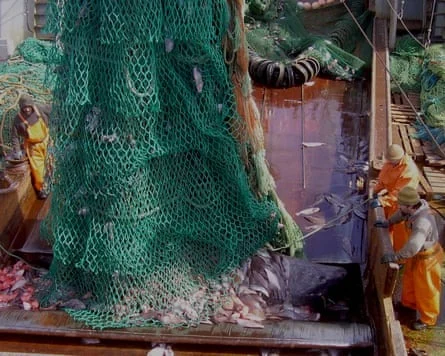
“When I accidentally catch a shark, I bring it to my dogs,” Henrik Jensen, a 27-year-old fisherman from Greenland’s west coast, says casually. “I don’t let it back down because [the sharks] bully me and cut my lines.”
Jensen has spent a decade fishing for halibut in Ilulissat, Greenland’s third-largest town. He operates his vessel about an hour north of the town’s main iceberg-laden fishery, a vibrant area that sustains the livelihoods of nearly 400 local fishers. Out on these deeper, colder waters, the Greenland halibut are noticeably bigger and far more plentiful, but the reward comes with a heavy price: an abundance of massive Greenland sharks that share the same deep-sea habitat.
The conflict between local fishers and these ancient predators has reached a boiling point. “This year I’ve lost around 6,000 hooks in total. Sometimes we lose 30,000 Danish krone [£3,440] a day,” says Jensen, illustrating the devastating financial toll that the incidental encounters take on independent operators who work in small teams on open dinghies.
The Greenland shark remains one of the least understood creatures on the planet. Recognized as the world’s slowest shark and the second-largest carnivorous fish species after the white shark—surpassed only in size by the great white—these giants can reach lengths of six to seven metres and live for more than four centuries. For generations, they were widely believed to be completely blind, though recent scientific discoveries have shown that this long-held assumption may not be true.
Inhabiting a vast range across the deep, freezing waters of the north and west Atlantic, Greenland sharks are drawn to the baited longlines set by northern fisheries targeting valuable commercial species like Greenland halibut and Atlantic cod. In their attempts to feed on the hooked fish, the sharks frequently become tangled in the gear, resulting in costly bycatch scenarios that frustrate fishers and damage expensive equipment.

This acrimonious coexistence has simmered ever since targeted commercial fishing for the sharks’ vitamin-rich liver oil officially ceased in the 1960s. However, the underlying tensions boiled over earlier this year when the Avannaata municipality, where Ilulissat serves as the administrative seat, approved a controversial plan to cull 1,000 Greenland sharks. Under the proposed municipal scheme, fishers would have been offered a bounty of 300 krone for every shark heart turned in.
Defending the initiative, Lars Erik Gabrielsen, mayor of the municipality, explained the rationale behind the local government’s decision: “We need to safeguard the income of fishermen and the catch so that we can continue to eat the foods that we have relied on for generations.”
For inshore fishers navigating narrow profit margins, the proposal brought a longstanding, daily frustration into sharp focus. Timotheus Petersen, chair of the local fishing association in Kullorsuaq, underscored the financial burden of the gear losses. “Our longlines are expensive—one costs 1,599 krone,” Petersen noted. “When the sharks cut our lines, we cannot finish fishing. We have to spend more money and buy new gear.”
Ultimately, the controversial cull plan was dropped after the national government questioned its legal standing, but local fishers and conservationists alike acknowledge that the prospect of a future cull remains very real.
In its original decision to greenlight the cull, the Avannaata council pointed to historical precedents, including a similar scheme launched in the early 2000s within the former Aasiaat municipality, which offered a bounty of 200 krone per shark. Furthermore, a report published in 2007 by the Danish Technical University documented another extensive bounty scheme operating between 1986 and 2001 in the former Uummannaq municipality, during which an astonishing 19,697 shark hearts were collected.
Despite these historical precedents, marine conservation groups argue strongly that culls offer no long-term solution to the challenges facing fishers. Organizations such as Oceans North Kalaallit Nunaat (ONKN) emphasize the highly migratory nature of the species, noting that individual Greenland sharks can swim up to 1,200 miles—or 2,000 kilometers—in a single year. “Sharks removed in north-west Greenland would quickly be replaced by individuals arriving from other regions,” ONKN warned in a public statement.
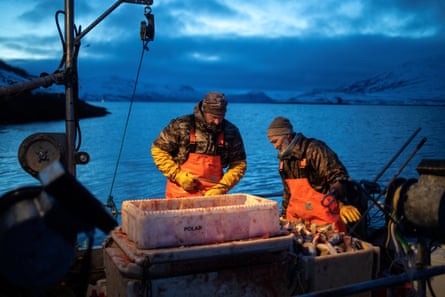
Many local fishers themselves are skeptical that a 300-krone bounty is worth the arduous physical labor of hauling a multi-ton, seven-meter-long predator onto a small vessel. “It’s difficult to catch them,” Jensen points out. “You need bigger hooks and chains for the lines, so I don’t think anyone wants to try.”
The prospect of large-scale culls has sounded alarm bells within the international scientific and conservation community. Prof Nick Dulvy, a marine conservationist at Simon Fraser University in British Columbia, voiced profound concern over the proposal. “If somebody says, ‘I’m going to cull a couple of thousand Greenland sharks’, that’s a disaster in my opinion,” Dulvy said.
Biologically speaking, the Greenland shark is uniquely vulnerable to population depletion. Researchers believe the species does not reach sexual maturity until it is roughly 150 years old. Because they mature at such an advanced age, the species replaces itself extremely slowly and cannot easily rebound from population shocks or organized culling efforts. The population is, in fact, still recovering from heavy, targeted commercial fishing throughout the 19th and mid-20th centuries, which reached a historic peak in 1948 when 58,000 sharks were landed.
“They are probably—biologically—the most sensitive species in the ocean to overfishing,” Dulvy warned. Globally, scientists estimate that roughly 3,500 Greenland sharks are unintentionally caught every year as bycatch, and the overarching population continues on a downward trajectory.
While Greenland’s fishing community is vocal about its longstanding friction with the sharks, analysts point out that the recent surge in frustration reflects deeper structural strains within the domestic economy. The fishing industry is the backbone of Greenland’s economy, accounting for approximately 25% of the country’s gross domestic product.
Jenseeraq Poulsen, director of ONKN, suggests that the heightened animosity toward the sharks is symptomatic of broader pressures facing the trade. “If every Greenland shark in Baffin Bay vanished tomorrow, the inshore fishery in Avannaata would still face too many boats working a quota under pressure, rising costs and no alternative employment,” he explains. “When margins are narrow, a longstanding nuisance becomes intolerable.”
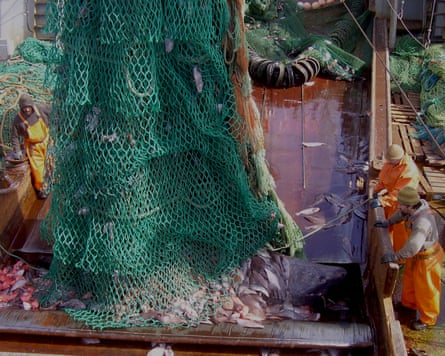
Although market prices for Greenland halibut continue to rise according to data from the Greenland Institute of Natural Resources, the average physical size of the fish being hauled ashore is decreasing year over year. Jensen maintains that he can still carve out a good living from the sea, but he notes that he is forced to deploy fewer hooks and is bringing in fewer fish overall—a trend he attributes in large part to heavy commercial overfishing by large offshore trawlers working the deeper channels.
At the same time, local fishers note that sharks are not the only, or even the primary, source of gear loss. “There are more and more ‘ghost lines’ and they are too heavy to pull up by the machine we use,” Jensen says. Ghost lines refer to discarded, lost, or abandoned fishing gear that drifts through Arctic waters, frequently entangling active fishing lines, breaking expensive equipment, and trapping unsuspecting marine wildlife in a cycle of persistent destruction.
To address these multifaceted challenges, alternative solutions are already being explored. Halibut Greenland, a cooperatively owned fish-processing company based in Ilulissat, provides funding for dedicated cleanup operations to remove ghost gear from local waters—an initiative that conservation groups like ONKN view as far more constructive than a marine cull. Additionally, Poulsen has proposed the establishment of a gear-loss compensation scheme for fishers, alongside government-funded trials to test acoustic shark deterrents that could keep the animals away from active longlines.
On a regulatory level, Rebekka Nygård Bak, an adviser to Greenland’s Ministry of Fisheries, Hunting, Agriculture and Self Sufficiency, suggests that introducing new rules mandating bycatch-friendly equipment could provide a viable path forward. She also notes that a broader national campaign aimed at improving bycatch reporting and data collection will be a critical foundational step for any future policy decisions.
For conservationists and community advocates like Poulsen, the sharks and the human fishers plying these icy northern waters are inextricably linked components of a single, shifting marine ecosystem, both trying to navigate an environment undergoing rapid change.
“The shark is the visible, tangible version of a problem whose real drivers are structural,” Poulsen concludes.

Related Posts